

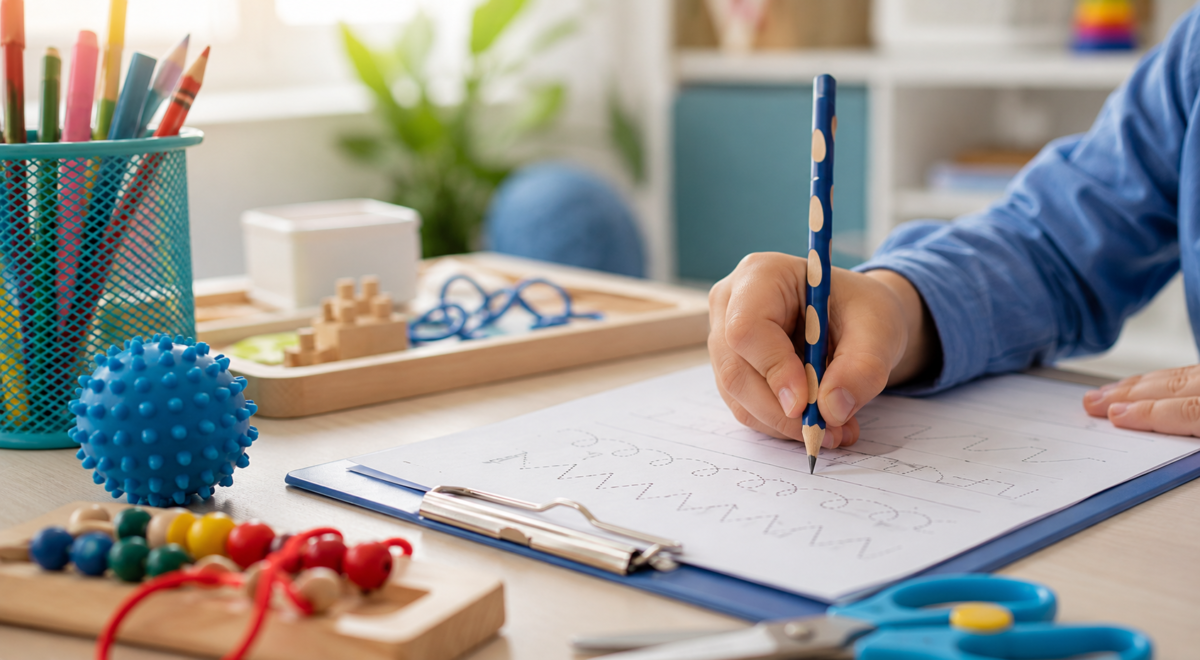
Handwriting is much more than putting letters on paper. At Angels Foundation, Gurugram, we understand that good handwriting depends on strong muscles, coordination, posture, and fine motor control. When a child struggles with handwriting, it is easy to assume they are careless or not trying hard enough. However, in many cases, messy handwriting is actually a sign that a child needs support in developing essential fine motor skills.
Understanding Fine Motor Skills
Handwriting is an umbrella skill that depends on several foundational abilities, not just fine motor strength. Children need hand strength, finger dexterity, bilateral coordination, eye-hand coordination, in-hand manipulation, and visual perceptual skills to write efficiently. Occupational Therapists assess these underlying skills and build them through engaging, functional activities.
When these muscles are not well developed, even simple classroom tasks can become tiring and frustrating.
Signs Your Child May Need Help
Parents and teachers should watch for these common signs:
- Weak or awkward pencil grip
- Poor hand strength and quick hand fatigue
- Difficulty writing neatly or staying within the lines
- Trouble using scissors
- Difficulty buttoning clothes or zipping jackets
- Avoiding colouring, drawing, or writing activities
- Complaints of hand pain after writing
Recognizing these signs early can help children receive the right support before handwriting challenges begin affecting their confidence and academic performance.
Why Handwriting Readiness Matters
Before children can write comfortably, they need a strong foundation of hand strength, finger coordination, and proper pencil control. Handwriting readiness includes:
- Strong hand and finger muscles
- Good wrist stability
- Bilateral coordination (using both hands together)
- Eye-hand coordination
- Proper posture while sitting and writing
Without these foundational skills, handwriting often becomes slow, messy, and exhausting.
How Occupational Therapy Helps
At Angels Foundation, our Occupational Therapy team focuses on developing the physical skills needed for everyday activities, including handwriting. Rather than simply asking children to write more, we identify the underlying challenges and create personalized activities to strengthen those skills.
Common Occupational Therapy exercises include:
- Theraputty or clay squeezing for hand strength
- Clothespin and tweezer games for finger control
- Bead threading to improve precision
- Cutting activities using child-safe scissors
- Pegboard and puzzle activities
- Pencil grip training
- Tracing and pre-writing pattern exercises
These activities make therapy engaging while gradually improving strength, coordination, and writing control.
Supporting Better Writing at Home
Parents can encourage fine motor development through fun daily activities such as building with blocks, playing with play dough, colouring, drawing, folding paper, stringing beads, or helping in simple kitchen tasks. These playful exercises naturally strengthen the muscles required for writing.
The Takeaway
Messy handwriting is not always a sign of laziness or lack of effort. Often, it reflects challenges with fine motor development that can be improved with the right guidance and practice. Early intervention through Occupational Therapy helps children build stronger hands, gain confidence, and develop the skills they need for success in school and everyday life.
Strong hands today create confident writers tomorrow. Early support can make all the difference.