

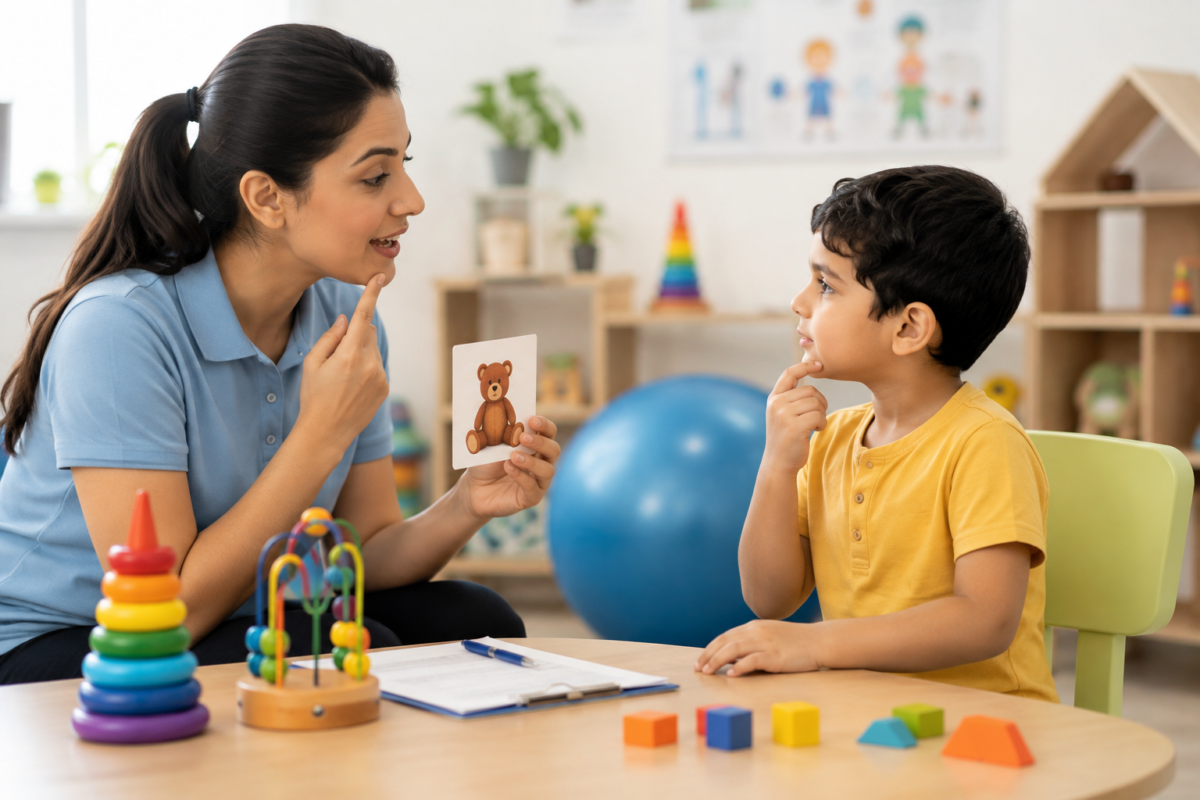
Many parents notice that their child understands instructions like “Bring your shoes,” “Come here,” or “Give the toy to Grandma,” but rarely responds with words. While every child develops at their own pace, consistently understanding language without expressing it may indicate a communication delay that deserves professional attention. Angels Foundation, Gurugram, is dedicated to helping children build communication, social, sensory, and developmental skills through evidence-based therapies. Early identification and timely intervention can significantly improve a child’s ability to express thoughts, interact confidently, and achieve developmental milestones.
Understanding the Difference Between Receptive and Expressive Language
Children develop language in two important ways. Receptive language is the ability to understand words, instructions, and conversations, while expressive language refers to the ability to communicate using words, gestures, or sentences. Some children have strong receptive language but struggle with expressive communication. This gap may be associated with speech and language delays, autism spectrum disorder, developmental delay, sensory processing difficulties, or oral motor challenges. Identifying the underlying cause is essential for effective intervention.
Signs That Your Child May Need Support
In our centre in Gurugram, our therapists encourage parents to seek an evaluation if they notice signs such as:
- Understands instructions but rarely speaks.
- Uses gestures instead of words.
- Has limited vocabulary for their age.
- Finds it difficult to form sentences.
- Avoids eye contact or social interaction.
- Becomes frustrated while trying to communicate.
- Struggles to express needs or emotions clearly.
Recognising these signs early allows therapy to begin during the most important years of brain development.
How Speech and Occupational Therapy Help
At Angels Foundation, our multidisciplinary team works together to improve both communication and overall development. Speech therapy focuses on building vocabulary, improving pronunciation, developing sentence formation, and strengthening social communication skills. Occupational therapy supports sensory processing, attention, motor planning, play skills, and self-regulation, all of which contribute to better communication and learning. When needed, therapy plans are personalised to match each child’s developmental needs and learning style.
The Importance of Early Intervention
Children’s brains are highly adaptable during their early years. Starting therapy at the first signs of concern often leads to faster progress, greater confidence, and improved academic and social outcomes. Waiting for a child to “grow out of it” may delay the support they need during this critical developmental window.
Helping Your Child Reach Their Full Potential
If your child understands what you say but struggles to respond, don’t ignore the signs. A professional assessment can provide clarity and guide the right intervention plan. With early support, consistent therapy, and active family involvement, children can develop stronger communication, independence, and confidence. At Angels Foundation, Gurugram, we are committed to helping every child unlock their full potential through compassionate, personalised speech and occupational therapy